
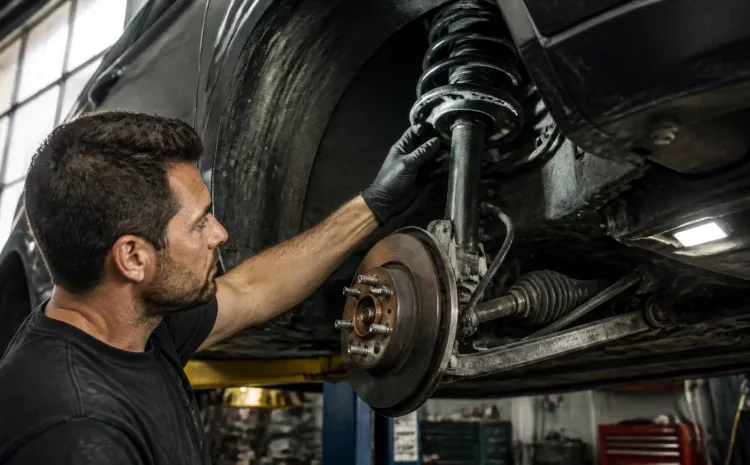
5 Signs Your Shocks and Struts Need Replacing : Before Your Ride Gets Rough
A comfortable ride is nice, but your vehicle’s suspension does much more than absorb bumps. Shocks and struts help keep your tires in contact with the road, control body movement, and support stable braking and steering.
When these components begin to wear out, the changes may start subtly. Your car might feel a little bouncier, lean more than usual, or make a noise over potholes. It is easy to dismiss those symptoms as normal aging: especially when you drive every day and gradually adjust to the way your vehicle feels.
However, worn shocks and struts can affect safety as well as comfort. If you notice any of the following signs, scheduling a professional inspection is a smart next step for drivers in Olympia and the surrounding communities.
Shocks and struts: What is the difference?
Both shocks and struts control suspension movement. In simple terms, they keep your vehicle from continuing to bounce after the springs react to a bump.
A shock absorber is primarily a damping component. It helps control the up-and-down movement of the suspension.
A strut also controls movement, but it is part of the vehicle’s structural suspension assembly. Depending on the design, it may support the spring, connect to steering components, and influence alignment.
The exact setup depends on your vehicle. Bron’s Automotive services both domestic and European cars, so the correct inspection and repair process will vary by make and model.
1. Your vehicle keeps bouncing after bumps
Your car should settle fairly quickly after going over a speed bump, pothole, or uneven patch of pavement. If it continues to bounce or feels unusually floaty, the shocks or struts may no longer be controlling suspension movement effectively.
You may notice this most often on:
- Rough Olympia streets
- Railroad crossings
- Speed bumps
- Driveways with steep transitions
- Uneven roads outside the city
A worn suspension can make the vehicle feel unsettled rather than simply firm. Instead of absorbing a bump and returning to a stable position, the body may move several times afterward.
This can also reduce tire contact with the pavement. Less consistent contact may affect traction, steering response, and braking: particularly on wet Washington roads.
Do not rely on a driveway bounce test alone
You may have heard of pushing down on one corner of the vehicle to see how many times it bounces. While unusual movement can be a clue, this is not a dependable diagnosis for every modern vehicle. Some suspension systems are designed to feel different, and other worn components can create similar symptoms.
If your ride has become noticeably bouncier, let a technician inspect the suspension, tires, steering, and related mounting hardware together.
2. The front end dives when you brake
Does the nose of your vehicle dip sharply when you apply the brakes? Some forward movement is normal because braking shifts weight toward the front wheels. Excessive nose-diving, however, can point to worn shocks or struts.
You may feel this when:
- Braking for a red light
- Stopping at the bottom of a hill
- Slowing quickly in traffic
- Pulling into a driveway or parking area
Worn damping allows the vehicle’s weight to shift more dramatically. That may make the car feel slower to settle after braking and less confident during sudden stops.
Suspension symptoms can overlap with brake problems, tire issues, or alignment concerns. A nose-diving vehicle should not automatically be assumed to need shocks alone. A complete inspection helps identify the actual cause before parts are replaced.
3. Your vehicle sways, leans, or squats
A vehicle that leans heavily during turns or sways during lane changes may have a suspension problem. You might feel as though the body is rolling from side to side, especially when taking a corner or changing direction at highway speed.
Other body-motion symptoms include:
- The rear of the vehicle squats when accelerating
- The car feels unstable in crosswinds
- The body continues moving after a turn
- You need more steering correction than usual
- The vehicle feels nervous on uneven pavement
These sensations can be unsettling because they affect your confidence behind the wheel. They can also indicate problems with other suspension parts, such as springs, sway bar links, bushings, or control arms.
That is why a professional suspension inspection and repair should evaluate the complete system: not just the component that is easiest to see.
4. You see fluid leaking from a shock or strut
Shocks and struts use hydraulic fluid to help control movement. When a seal begins to fail, fluid can leak around the shock or strut body.
Look for a component that appears:
- Wet or oily
- Darkened with dirt stuck to it
- Noticeably different from the unit on the opposite side
- Coated with fluid near the piston rod or housing
A light film of residue does not always mean immediate failure, and road grime can make visual inspection difficult. Still, visible leakage is a good reason to have the vehicle checked.
As fluid loss increases, the component may lose its ability to control suspension movement. The result can be a rougher ride, more bouncing, or reduced stability. Do not crawl beneath a vehicle supported only by a jack. If you see a leak, describe its location to your technician or arrange an inspection.
5. Your tires are wearing unevenly
Your tires can provide valuable clues about suspension condition. If the suspension is not keeping the tire firmly and evenly against the road, the tread may develop unusual wear patterns.
One example is cupping, also called scalloping. This creates a repeating pattern of high and low spots around the tread. You may feel it as vibration or hear a rhythmic humming that becomes more noticeable at certain speeds.
Also watch for:
- One edge wearing faster than the rest
- Patchy wear across the tread
- Tread that feels uneven when you run your hand across it
- A tire that keeps wearing abnormally after rotation
Uneven tire wear can also result from incorrect tire pressure, poor alignment, worn steering parts, or an imbalance. Replacing shocks or struts without checking those other causes may not solve the problem.
If you notice unusual tread wear, schedule a suspension and alignment evaluation before buying new tires. A timely inspection may help protect the tires you already have.

What about clunking or knocking sounds?
Clunks, knocks, squeaks, or rattles over bumps deserve attention, even though noise was not one of the five main signs above. A sound from the suspension may come from a worn strut mount, loose hardware, sway bar link, bushing, ball joint, or another component.
Pay attention to when the noise occurs:
- Only over bumps
- While turning the steering wheel
- During braking or acceleration
- When backing out of a driveway
- On one side of the vehicle
The timing and location can help a technician narrow down the cause. Avoid assuming that every suspension noise means the shock or strut itself has failed.
How urgently should you schedule shocks and struts replacement?
Make an appointment soon if you notice one persistent symptom, especially visible fluid leakage or unusual tire wear. If you are experiencing several signs at once: such as bouncing, nose-diving, and swaying: limit unnecessary driving until the vehicle is inspected.
You should also arrange an inspection after:
- Hitting a major pothole
- Striking a curb
- Being involved in a collision
- Carrying unusually heavy loads
- Noticing a sudden change in handling
There is no universal replacement mileage that applies to every vehicle. Driving habits, road conditions, vehicle weight, suspension design, and maintenance history all matter. Mileage can be one factor, but how the vehicle behaves is just as important.
What happens during a suspension inspection?
At Bron’s Automotive, an inspection can include checking the shocks or struts for leakage, damage, and abnormal movement. Technicians may also examine springs, mounts, bushings, control arms, sway bar links, steering components, tires, and alignment-related concerns.
If replacement is recommended, shocks or struts are commonly replaced in pairs on the same axle so both sides respond consistently. The proper procedure depends on the vehicle and the condition of the surrounding components. Your technician should explain what was found, what needs attention now, and what can be monitored.
Bron’s is a family-owned auto repair shop serving Olympia since 2002. Our ASE-certified technicians work on domestic and European vehicles, and our team is committed to explaining repairs clearly and treating customers with respect. We are also a NAPA Autocare and Approved Auto Repair service, recognized as Best of South Sound in 2023.
For additional maintenance guidance, see our article on steering and suspension system maintenance.
Bring back a smoother, more controlled ride
A rough ride is not always “just an old car.” Bouncing, nose-diving, swaying, fluid leaks, and uneven tire wear can all signal that your shocks or struts are no longer doing their job properly. Because suspension condition affects handling, braking, and tire contact, it is worth addressing these symptoms before they become a larger problem.
If your vehicle feels unsettled around Olympia, make an appointment with Bron’s Automotive for a suspension inspection. Call (360) 943-5993, visit us at 2021 Harrison Ave NW, Olympia, WA 98502, or request an appointment online. We will help you understand what your vehicle needs and recommend the next step without the guesswork.